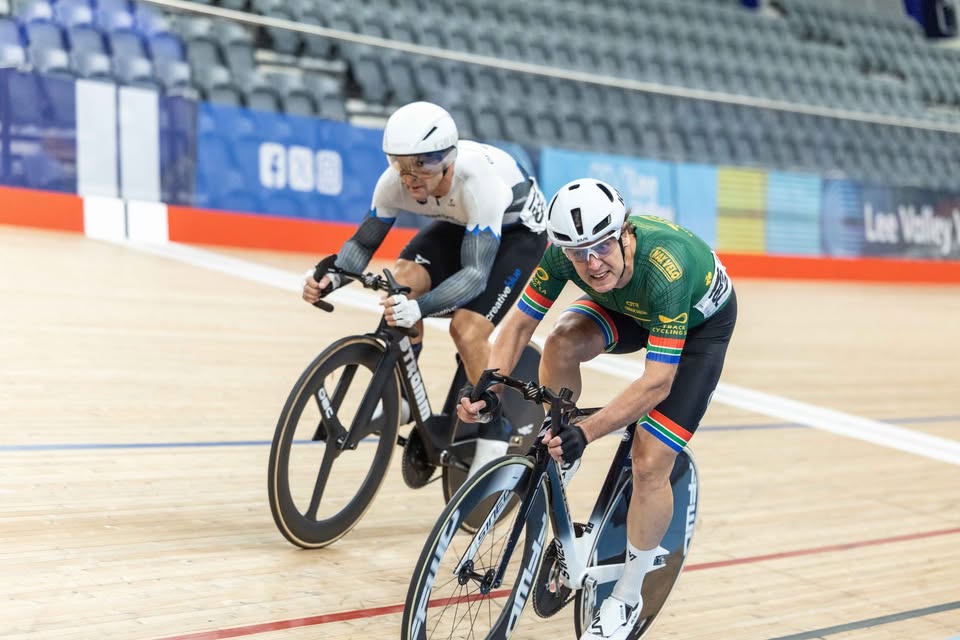
Jaco Scholtz represented Track Cycling SA club at the event in the 50-54 age category.
P11 in the 2000m IP
P13 in the points race
P6 in scratch qualifying event
P21 in the scratch final
Valuable experience was gained and the pursuit effort was executed well and in a PB time. All the bunch race finals were at 50kmh average. This has now become the norm for masters racing and is a strong indication that local racing in South Africa needs to be at higher speeds.
Every masters cyclist wants to be stronger in summer — but the truth is, that strength is built right now. Winter is the engine‑building season, the time when you lay down the aerobic foundation that determines everything: your recovery, your race durability, your ability to handle intensity later in the year. Principle 1 is simple but powerful: build the aerobic engine first. The rest of your performance depends on it.
Build the aerobic engine first
Why Aerobic Training Matters More With Age?
As we get older, two things happen:
VO₂ max declines naturally
Recovery from high‑intensity work becomes slower
But the aerobic system remains incredibly adaptable. You can still make meaningful gains in:
Endurance
Fatigue resistance
Oxygen delivery
Metabolic efficiency
(These four points are topics for the future!)
A strong aerobic base also protects you from injury, supports hormone balance, and improves long‑term health — not just cycling performance.
How to Build a Strong Aerobic Engine This Winter?
1. Prioritise Zone 2 Training
Zone 2 is where the magic happens for masters athletes. It improves mitochondrial density, fat utilisation, and endurance without creating unnecessary fatigue. Most riders think they’re in Zone 2… but drift into tempo. That’s why using both heart rate and power is essential.
2. Increase Weekly Aerobic Volume Gradually
You don’t need massive hours — you need consistent hours. Add 15–30 minutes per week, not 2–3 hours at once. Small increases compound beautifully over winter.
3. Use HR + Power to Stay Disciplined
Power tells you what you’re doing. Heart rate tells you how your body is responding. Together, they keep you honest and prevent endurance rides from becoming “accidental tempo”.
4. Avoid Turning Endurance Rides Into Tempo Rides
This is the biggest mistake masters cyclists make. Tempo is useful — but only when it’s planned. If every endurance ride becomes a tempo ride, you lose the aerobic benefits and accumulate unnecessary fatigue.
The Payoff: Everything Gets Better
A strong aerobic base improves:
Recovery between sessions
Strength training quality
High‑intensity performance
Race durability
Long‑term health and resilience
It’s the engine that keeps you competitive well into your 40s, 50s, and beyond.
MaxVelo Note
This winter, I’m intentionally focusing on my own aerobic foundation as I prepare for the start of track season in July and the build toward Worlds in October. Yes, I still include two quality interval sessions each week — but those sessions only work because the aerobic engine underneath them has been compounding for years. That’s the real secret for masters athletes. You don’t need more intensity; you need more focus, more discipline, and more commitment to the fundamentals. And it all starts with the aerobic base.
How to Build a Winter Training Rhythm That Works?
Winter is the perfect time to simplify your structure:
2–3 key sessions per week
1–2 easy endurance rides
Optional indoor technique or cadence work
Strength training once or twice a week
Small, repeatable habits beat complicated plans. If you miss a day, you don’t “start over” — you just continue the rhythm.
Local races: Show Up, Stay Sharp
Racing winter is one of the best ways to maintain consistency. You don’t need peak form — you just need to participate. Racing in winter keeps your skills sharp, your motivation high, and your training purposeful.
If you’re unsure whether to race, the answer is almost always yes. Category specific winter road races and club events are ideal for masters who want to stay sharp.
MaxVelo Note
This winter, I’m sharing my own training rhythm as I prepare for the start of track season in July. Masters athletes thrive when they train with purpose — and that purpose shifts through the year. In summer, my entire focus was on peaking for the Track races in Manchester and London. Everything revolved around sharpening my 2–5 minute power for the individual pursuit. Shorter, high‑quality intervals. High cadence work. Precision. Specificity.
Winter is different. Now I’m deliberately stepping into the longer events in the WP Winter League to stimulate new adaptations. These races force me to work on the parts of my engine that matter most for masters athletes: 20‑minute power, 60‑minute power, and the ability to stay strong late in a race. It’s uncomfortable, but it’s exactly the kind of stimulus that builds the aerobic depth I’ll rely on later in the year.
This rhythm — shifting from peak‑specific work in summer to aerobic development in winter — is what keeps performance progressing year after year. Masters athletes don’t need more intensity; they need the right intensity at the right time, anchored by a strong aerobic foundation. And that’s what we’re building together this winter.
If this newsletter helped you refocus your winter training, share it with another masters cyclist who could benefit from a stronger aerobic foundation. The MaxVelo community grows one purposeful rider at a time. SUBSCRIBE
Between November 2024 and April 2026, I engaged in continuous, good‑faith communication with the City of Cape Town regarding the future of the Bellville Velodrome — South Africa’s only Olympic‑sized, fully roofed cycling track and the only indoor velodrome on the African continent.
Over this two‑year period, I consistently highlighted the velodrome’s national sporting importance, its role in youth development and community safety, and its value as a high‑performance training venue for current and future South African athletes. I also proposed practical, low‑cost operating models and offered constructive solutions at every stage.
Despite this, the City confirmed at a stakeholder meeting in April 2026 that the cycling track will be permanently removed when the facility is handed to a private developer in January 2027. The velodrome will be converted into a 15 000‑seat events arena, and Olympic‑standard track cycling will no longer form part of the site’s future.
A summary of the engagement timeline
• November 2024 – June 2025: Initial correspondence with the Mayor raised concerns about possible sale or closure. I outlined the velodrome’s strategic importance and proposed a sustainable maintenance model. The matter was acknowledged but no commitments were made.
• July – August 2025: The annual use licence was not renewed, placing training and events at risk. The City restricted access due to OHS issues and prohibited formal competitions. I engaged Cycling South Africa and proposed collaborative solutions. Limited access was restored, but uncertainty remained.
• August 2025 – January 2026: The velodrome was closed for renovations with no clear timelines. I documented the impact: riders unable to train, youth and women’s programmes collapsing, and national‑level athletes losing preparation time. I requested a meeting and proposed a non‑profit operating model based on international best practice.
• April 2026: At a City stakeholder meeting, it was confirmed for the first time that the cycling track would be demolished under a 60‑year development lease agreement. This was an extension of the one awarded in 2009. The City stated that high‑performance Olympic‑standard facilities fall outside its mandate and that its focus is on grassroots community amenities.
What this means for South African track cycling
I welcome the City’s investment in refurbishing the Vygieskraal 500 m outdoor track. Outdoor tracks are essential for grassroots development and community access. However, they are internationally recognised as feeder facilities — not replacements for enclosed Olympic‑standard velodromes.
With the loss of Bellville, South Africa will no longer have a roofed, Olympic‑sized track for high‑performance training, national events, or international competition preparation. This is a significant setback for the sport, for athlete development, and for future generations who will not have access to the same opportunities.
My position going forward
Although I am deeply disappointed by the outcome, I remain committed to constructive engagement and to building a sustainable future for track cycling in the Western Cape and South Africa. The focus now shifts to:
strengthening youth and community programmes i.e. Learn to race time trails on the road hosted at Steynsrust Hill, Somerset West
maximising the potential of Paarl and Vygieskraal
developing a long‑term high‑performance pathway in the absence of an indoor velodrome through Track Cycling SA club
ensuring that the history and impact of the Bellville Velodrome are properly recorded
For two years, I advocated with transparency, evidence, and respect. While the final decision is not the one the cycling community hoped for, the work to protect and grow the sport continues.
Jaco Scholtz Track Cycling SA Somerset West, Cape Town
In this episode of Balls to the Wall, Jaco Scholtz discusses the significance of cycling clubs in South Africa, particularly in track cycling. He reflects on the history and development of club championships, the importance of community engagement, and the upcoming events that foster youth participation and competition in cycling. The conversation emphasizes the role of clubs as foundational elements in nurturing talent and promoting the sport.
Key take outs:
Cycling clubs are essential for the development of track cycling in South Africa.
The Track Cycling SA club championship has been a consistent event for 12 years.
Community engagement is vital for the success of cycling events.
Youth participation is encouraged through learn-to-ride programs.
The championship handicap format allows for fair competition across different age groups.
Social events after races help build community spirit.
Investing in clubs is crucial for the future of cycling in South Africa.
Upcoming events aim to attract more participants from various regions.
The atmosphere at events is both competitive and social.
The success of young riders showcases the effectiveness of club training.
🚴♂️ Cape Town Cycle Tour 2026 – Train Smarter, Ride Stronger The countdown is on! This 12‑week program is built for intermediate cyclists who want to arrive on 8 March 2026 with confidence, endurance, and speed.
✅ 6–8 hours per week ✅ Aerobic base, muscular endurance, climbing & sprint work ✅ Structured sessions with heart rate tracking (smart trainer recommended) ✅ Clear goals and measurable progress
💡 Whether it’s conquering climbs or unleashing a sprint finish, this plan ensures you’re ready for race day.
Don’t miss out on our online coaching plan for cyclists who dream big! We only have 8 spots open for our September cohort. Receive a month-long strength training program worth R300 when joining before 5 September 2025.
Big dreams realised:
Keanu Pieterse – multiple SA scholars track champion
Pierre van Zyl – SA masters track champion
Danie van Onselen – SA masters track champion and provincial tt champion
Track Cycling SA is a high-performance cycling club that focuses on youth development. Learn to race is a new initiative to help riders to progress from recreational cyclists to competent racers. Events are focused on u15 and older.
This is done through Track Cycling SA club training rides that cover:
Road cycling
Time trails
Hill climbs
Criteriums
Track cycling
TT
Flying 200m
Pursuit
Bunch race simulations
The training rides are led by an UCI and TrainingPeaks certified coach with The Guardian clearance and a first aid level 2 qualification.





 SA Omnium Champs incoming…
 WP Track League wrapped—overview, highlights, and standout performances
 SA Omnium Champs on 11 Oct—Westbourne velodrome is about to host something special
 C
C
